
Quick Answer: Focused vs Radial Shockwave: Key Differences Explained
Health, Pain Management, Focused Shockwave, Radial Shockwave, Shockwave Therapy
Focused vs Radial Shockwave: What’s the Difference (and Why It Matters for Results)
In the world of modern pain management, Shockwave Therapy has become synonymous with sophistication and efficiency. Yet behind this elegant term lies not one technology, but distinct approaches: focused shockwave and radial shockwave. Understanding the difference is not merely academic—it is the difference between a treatment that feels indulgently precise and one that feels disappointingly underwhelming.
Shockwave Therapy Is Not a Single Technology
Many patients arrive at a clinic saying, “I’ve heard HyperWave focused shockwave therapy works wonders—do you offer it?” The assumption is that shockwave is one uniform treatment, like a single brand of luxury skincare. In reality, there are two very different technologies under the same name: focused shockwave and radial shockwave. They share a philosophy—using acoustic energy to stimulate healing—but they differ profoundly in how that energy is delivered into your tissues.
Imagine lighting a room. You can use a spotlight, directing a concentrated beam at a specific piece of art, or a floodlight, bathing the entire space in softer, more diffuse light. Both are “light,” yet their effects are entirely different. When it comes to stubborn pain conditions, that distinction is everything.
HyperWave Focused Shockwave: A Precision Spotlight for Deep, Targeted Healing
Focused shockwave therapy is designed to concentrate energy at a specific, controllable depth beneath the skin—much like a spotlight illuminating a single, exquisite detail. The device generates acoustic waves that converge at a focal point inside the tissue, where the therapeutic effect is most intense. The practitioner can adjust this focal depth, directing the energy precisely where the pathology lives, whether that is a deep tendon insertion or a calcific deposit embedded in a shoulder tendon.
In luxury terms, think of focused shockwave as a bespoke treatment: carefully measured, meticulously tailored, and designed around the unique architecture of your anatomy. It is particularly suited to conditions where accuracy is non-negotiable—where the problem is not at the skin’s surface, but deeper, at a clearly defined point that must be reached with enough energy to create change without damaging surrounding structures.
💡 Pro Tip: When a clinic talks about adjusting “treatment depth” and “focal zone,” they are usually referring to Focused Shockwave, not radial.
Radial Shockwave: A Gentle Floodlight for Broader Tissue Areas
Radial Shockwave Therapy, sometimes called radial pressure wave therapy, distributes energy in a very different way. Instead of converging at a deep focal point, the energy radiates outward from the applicator tip, with the highest intensity at the skin surface and gradually diminishing as it travels deeper. This is your therapeutic floodlight—broad, diffused, and ideal for treating larger regions of tissue rather than a single pinpoint structure.
Radial shockwave can be beautifully effective for superficial or moderately deep issues, muscle tension, and areas where the goal is to influence a broader network of tissue rather than a specific microscopic target. But it does not offer the same depth control or intensity at a precise point as focused shockwave. When a condition demands deep, pinpoint accuracy, relying solely on radial technology can be like trying to highlight a single word in a book using only a lampshade.
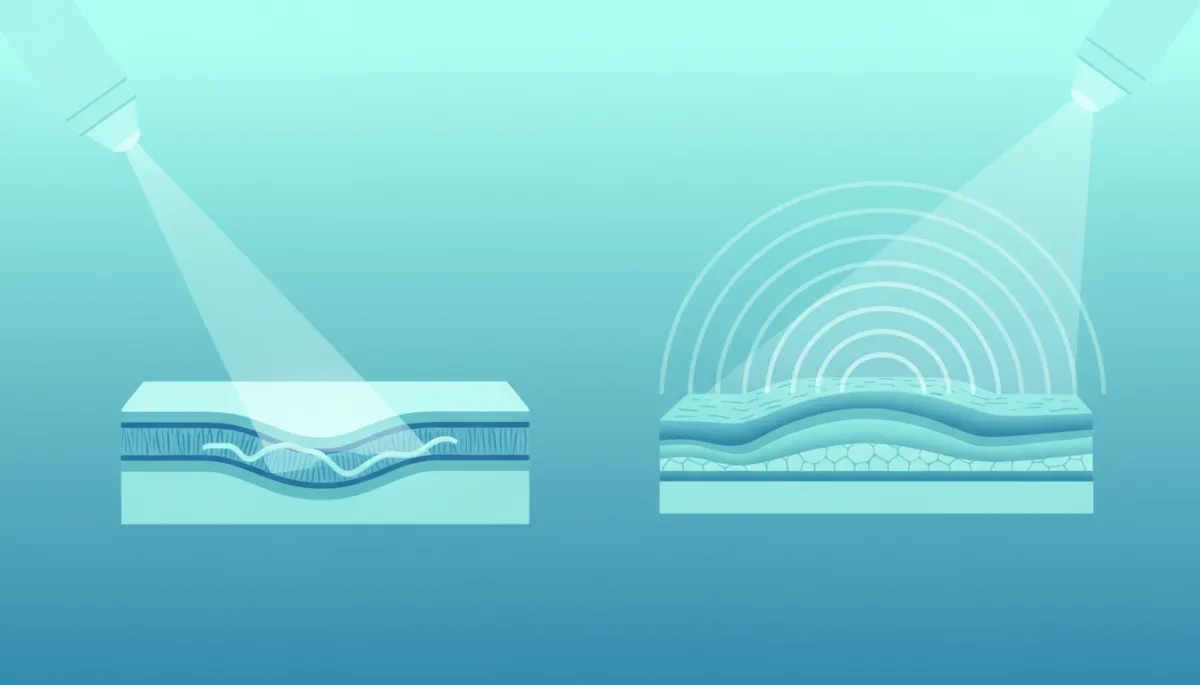
Matching spotlight-like focused energy or floodlight-like radial energy to the tissue depth is crucial for elegant, reliable results.
Why Focus Matters for Chronic Tendinopathies, Plantar Fasciitis, and Calcific Tendinitis
Chronic Tendinopathies: Precision for Stubborn, Deep-Seated Pain
Chronic tendinopathies—such as Achilles tendinopathy, patellar tendinopathy (jumper’s knee), or gluteal tendinopathy at the side of the hip—often involve degenerative changes in a specific segment of the tendon. The diseased tissue may be several millimetres beneath the surface, anchored at a bone-tendon interface or a deep tendon portion that cannot be adequately influenced by superficial energy alone. This is where HyperWave focused shockwave truly shines.
By directing energy to the exact depth of the pathological tendon tissue, focused shockwave encourages local blood flow, stimulates cellular activity, and promotes regeneration in a way that feels both clinically sophisticated and physiologically precise. For many chronic tendinopathies, relying solely on radial shockwave can feel like gently massaging the surface of a problem that lives deeper—soothing, but not transformative. The focus is what allows a treatment to reach the true source of pain rather than merely the area that hurts when touched.
Plantar Fasciitis: Depth, Density, and the Architecture of the Foot
Plantar fasciitis is a classic indication for shockwave therapy, yet not all plantar fascia cases are created equal. The plantar fascia is a thick, fibrous band at the bottom of the foot, attaching into the heel bone. In many patients, the primary pathology lies at the deep insertion into the calcaneus, not just in the superficial tissue you can massage by hand. This is where HyperWave focused shockwave can feel like a finely tuned instrument, delivering energy past the skin and soft tissue, directly into the affected interface where fascia meets bone.
Radial shockwave can still play a valuable role—especially for the more superficial components of plantar heel pain, surrounding musculature, and broader tissue sensitivity. However, for those truly stubborn, long-standing cases that have resisted conventional care, the ability of focused shockwave to concentrate energy at a specific depth is often the difference between “it helped a bit” and “it finally changed everything.”
Calcific Tendinitis: When You Need a Laser, Not a Lantern
Calcific tendinitis, particularly in the shoulder (such as calcification in the supraspinatus tendon), is a condition where a calcium deposit forms inside the tendon itself. This deposit is often clearly visible on imaging and located at a specific depth. The therapeutic goal is not just to comfort the surrounding tissue but to influence the calcific focus directly—encouraging fragmentation, resorption, and ultimately relief from the mechanical irritation it causes.
In these scenarios, HyperWave focused shockwave is typically the technology of choice. Its ability to deliver high-energy pulses into a defined focal zone makes it uniquely suited to targeting calcific deposits. Radial Shockwave, with its more superficial and diffuse pattern, simply cannot deliver the same level of concentrated energy at the exact depth of the deposit. For calcific tendinitis, using only radial technology can feel like trying to sculpt marble using only warm water.
📌 Key Takeaway: The deeper and more precisely located the pathology—especially in chronic tendinopathies, plantar fasciitis, and calcific tendinitis—the more critical it becomes to have focused shockwave available, not just radial.
Why Patients Experience Mixed Results with Shockwave Therapy
If you have heard stories of shockwave therapy being “life-changing” from one person and “barely noticeable” from another, you are not alone. Mixed results are common—but often avoidable. They rarely mean the technology itself is ineffective; more often, they reflect mismatches between technology, diagnosis, and protocol. In a refined clinical setting, these mismatches are carefully avoided. Here are some of the most frequent reasons results vary:
1. Using radial shockwave for a Deep, Focal Problem – A deep Achilles insertional tendinopathy or a calcific shoulder lesion may not receive sufficient energy at the correct depth when treated with radial only. The treatment may feel intense on the surface yet fail to influence the true source of pain.
2. Inadequate Assessment of Tissue Depth – If the clinician does not carefully assess how deep the pathology lies—often via palpation, ultrasound, or imaging—energy may be delivered too superficially or too deep. Even with focused shockwave, an incorrect focal depth setting can mean the therapeutic “spotlight” misses its target.
3. Suboptimal Treatment Parameters – Value is in the details, and so is efficacy. Energy levels, number of pulses, frequency, and number of sessions must all be tailored to the individual. Under-dosing can lead to underwhelming results; over-dosing can increase discomfort without added benefit. A refined clinic will adjust parameters thoughtfully, not simply follow a generic template.
4. Incomplete Integration with Rehabilitation – Shockwave therapy is a powerful stimulus, but it is not a stand-alone magic wand. When not combined with an intelligent rehabilitation plan—such as specific loading exercises for tendons—the long-term outcome may fall short of its potential. Think of shockwave as the catalyst and rehab as the architecture that consolidates the change.
5. Misdiagnosis or Overlapping Pain Sources – Sometimes the pain that feels like plantar fasciitis, for example, may be partly referred from the lower back or a nerve entrapment. If the underlying diagnosis is incomplete, even the most beautifully delivered focused shockwave or radial shockwave will only address part of the story.
When these elements are handled with care—choosing the correct technology, calibrating depth and dosage, integrating rehabilitation, and confirming the diagnosis—Shockwave Therapy often delivers results that feel not only effective but elegantly transformative.
Focused vs Radial Shockwave Are Not Interchangeable
It is tempting to think of focused shockwave and radial shockwave as simply two versions of the same luxury service—like different fragrances from the same perfumer. In reality, they are distinct instruments with overlapping but not identical capabilities. One does not replace the other, and they should never be treated as interchangeable in a high-level pain management setting.
Focused Shockwave is ideal when the pathology is deep, well-defined, and structurally specific—such as chronic tendinopathies at tendon insertions or calcific deposits. It is the technology of choice when precision and depth control are paramount.
Radial Shockwave is best suited to broader, more superficial, or regional pain patterns—including muscular tension, superficial tendons, or areas where a wider therapeutic field is desirable.
A truly elevated clinic will not simply offer “shockwave.” It will offer the right kind of shockwave, matched thoughtfully to your diagnosis, tissue depth, and personal goals. In some cases, the most refined approach blends both technologies in a complementary way—using focused shockwave for the deep target and radial shockwave for the surrounding soft tissue environment.
💡 Pro Tip: If a clinic speaks about HyperWave focused shockwave, focused shockwave or radial shockwave as if they are identical, that is a sign to ask deeper questions before you commit.
Essential Questions to Ask a Clinic Before Booking HyperWave Shockwave Therapy
Choosing HyperWave shockwave therapy should feel like selecting a bespoke service, not picking a random treatment from a menu. Before booking, consider asking the following questions to ensure the clinic’s approach aligns with the level of care and precision you expect:
“Do you use HyperWave focused shockwave, focused shockwave, radial shockwave, or a combination?”
You deserve clarity. A high-calibre clinic will explain which technology they use and why. If they only offer radial but present it as equivalent to focused for all conditions, proceed with caution—especially if you have chronic tendinopathy, plantar fasciitis, or calcific tendinitis.“How do you determine the appropriate treatment depth?”
For HyperWave Focused Shockwave, depth selection is critical. Ask whether they use imaging (such as ultrasound), detailed palpation, or anatomical landmarks to decide the focal depth. A refined practice will be able to describe this process with confidence and detail.“What protocol do you typically use for my specific diagnosis?”
Whether your concern is Achilles tendinopathy, plantar fasciitis, or calcific tendinitis, ask how many sessions are usually recommended, at what intervals, and with what energy settings. Look for a thoughtful, individualized answer rather than a one-size-fits-all script.“How do you integrate HyperWave Shockwave Therapy with rehabilitation or exercise?”
An elevated pain management strategy rarely relies on a single modality. Ask how HyperWave shockwave therapy will be combined with strengthening, mobility work, or load management to secure lasting results—not just temporary relief.“What outcomes have you seen for patients with conditions like mine?”
Invite them to share typical response patterns, expected timelines, and how they measure success. A sophisticated clinic will speak in terms of function, pain reduction, and return to activity—not vague promises.“How do you adjust the treatment if my response is different from expected?”
Your body is unique. Ask how they tailor energy levels, focal depth, or session frequency if your response is faster or slower than average. Adaptability is a hallmark of high-end care.
📌 Key Takeaway: The most important aspect of Pain Management is not a device itself, but the level of thoughtfulness and expertise guiding how that device is used for you.
Elevating Your Pain Management Journey with the Right Shockwave Choice
Living with chronic pain—whether from a long-standing tendinopathy, persistent plantar fasciitis, or a calcific tendon—is more than a physical burden. It is an interruption to the way you move, work, and enjoy the finer details of your life. HyperWave shockwave therapy, when thoughtfully applied, offers a way to address that pain with the same level of refinement you expect from other areas of your wellness routine.
Understanding the distinction between focused shockwave and radial shockwave empowers you to choose a clinic that treats your body with precision, not approximation. Focused shockwave acts as a spotlight, delivering energy exactly where your tissue needs it most, particularly in deep, focal pathologies. Radial shockwave offers a complementary, floodlight-style effect for broader, more superficial regions. Neither is inherently “better”—but each is exquisitely suited to specific situations.
When a clinic respects this difference, aligns the technology with a clear diagnosis, and tailors the protocol to your individual anatomy and lifestyle, HyperWave becomes more than a treatment—it becomes a curated experience in modern Pain Management. The result is not just less pain, but a more graceful return to the activities and movements that define your quality of life.
As you consider your next step, remember: HyperWave focused shockwave and radial shockwave powerful tools, but they are not interchangeable. Seek out a setting where technology is matched to diagnosis with the same discernment you apply to all your most important choices. Your body—and your lifestyle—deserve nothing less.