
ESWT for Chronic Low Back Pain: What the Research Says
ESWT for Chronic Low Back Pain: What the Research Says
Chronic low back pain can be a stubborn, life-shrinking problem. It’s also incredibly common—so common that most people either deal with it personally at some point or know someone who does.
When pain lasts longer than a few months, it’s rarely just a “back issue.” Chronic low back pain (CLBP) often involves a mix of physical, behavioral, and lifestyle factors, and even with active treatment, full recovery within a year isn’t guaranteed.
That’s why many patients (and clinicians) are looking for additional noninvasive options that can complement rehab and help people get moving again.
One therapy that’s been getting more attention is extracorporeal shockwave therapy (ESWT).
In a 2021 systematic review and meta-analysis of randomized controlled trials, Yue and colleagues evaluated whether ESWT is effective and safe for chronic low back pain—and the results were encouraging in the short term.
First: what is ESWT?
ESWT is a noninvasive treatment that delivers acoustic “shockwaves” through the skin to targeted tissues. It was originally introduced in clinical practice for urologic conditions, but its use has expanded widely across musculoskeletal care.
For low back pain specifically, ESWT is still emerging. Many clinical guidelines haven’t formally recommended it yet—largely because the evidence base has historically been limited. Yue et al. (2021) set out to update that picture using only randomized controlled trials.
What the researchers looked at
Yue et al. performed a systematic review and meta-analysis following PRISMA standards and registered their protocol in PROSPERO (CRD42021250013). They searched multiple databases, trial registries, and grey literature up to April 30, 2021.
They included randomized controlled trials that:
Enrolled adults (18+) with low back pain lasting more than 3 months
Compared ESWT (alone or combined with other therapies) against sham ESWT or other active treatments
Reported outcomes for pain intensity and/or disability
Who was included?
Across 10 randomized controlled trials, the analysis included 455 participants, generally young to middle-aged adults (roughly 29 to 56 years old).
Treatment protocols varied, but the reported energy flux density (EFD) ranged from 0.1 to 0.18 mJ/mm², and treatment schedules ranged from once weekly for 3 weeks to twice weekly for 6 weeks.
Comparators included sham treatment and other active approaches such as medication, exercise programs, TENS, manipulation, thermomagnetic therapy, and trigger point injections.
What they found: pain improved at 1 month
When results were pooled, ESWT was associated with a significant reduction in pain at 1 month compared with control/comparator treatments.
The meta-analysis reported:
Pain intensity at 1 month: SMD = −0.81 (95% CI −1.21 to −0.42)
At 3 months, the pooled pain reduction was not statistically significant in this analysis:
Pain intensity at 3 months: SMD = −0.39 (95% CI −0.97 to 0.19)
Translation: based on the available RCTs, ESWT appears to help many people feel better relatively quickly, but longer-term pain outcomes are less certain from this dataset.
Disability improved at 1 month and 3 months
Beyond pain scores, the review also looked at functional disability (often measured by tools like the Oswestry Disability Index).
They found:
Disability at 1 month: SMD = −1.45 (95% CI −2.68 to −0.22)
Disability at 3 months: SMD = −0.69 (95% CI −1.08 to −0.31)
This is an important point for real life: many people don’t just want “less pain”—they want to move better, work better, and get back to normal routines.
What about safety?
Across the included trials, no serious shockwave-related adverse events were reported.
That said, the authors note a limitation: adverse events weren’t always tracked or described consistently across studies. One trial reported that some patients experienced pain during the ESWT procedure.
Why isn’t ESWT in every guideline yet?
Yue et al. are careful about the strength of the evidence.
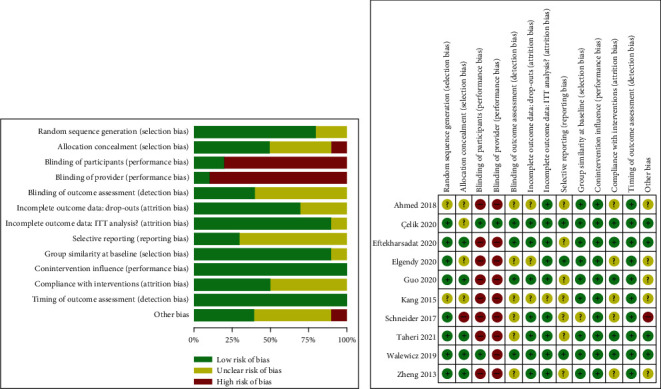
Even though the pooled results show measurable short-term benefits, the authors rate parts of the evidence as low to very low quality (depending on the outcome and time point), due to issues like small sample sizes and clinical diversity across trials (different causes of pain, different protocols, different comparators).
Their conclusion is balanced:
ESWT produced quantifiable short-term reductions in pain and disability
But more well-designed, larger RCTs are needed to strengthen confidence and clarify optimal protocols and patient subgroups
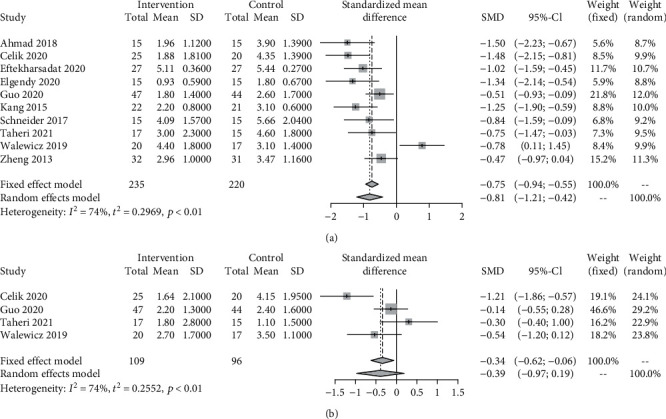
Standardized mean difference (SMD) with 95% confidence intervals (CI) of pain intensity at month 1 (a) and month 3 (b) for extracorporeal shock wave therapy (ESWT) versus comparators for chronic low back pain. Pooled SMD calculated by random-effects model.
The HyperWave takeaway
If you’re dealing with chronic low back pain, ESWT may be a promising noninvasive option—especially for short-term pain relief and functional improvement—when used as part of a broader plan.
In practice, many patients do best when therapies like ESWT are paired with a foundation of movement-based care (e.g., physical therapy, progressive strengthening, and load management). The research suggests ESWT may help “open the door” to better function—so you can do the work that creates longer-term change.
Reference
Yue L, Sun MS, Chen H, Mu GZ, Sun HL. Extracorporeal Shockwave Therapy for Treating Chronic Low Back Pain: A Systematic Review and Meta-analysis of Randomized Controlled Trials. Biomed Res Int. 2021;2021:5937250. doi:10.1155/2021/5937250. PMID: 34840977; PMCID: PMC8617566.
Educational content only. This article is not medical advice. Talk with a qualified clinician to determine whether ESWT is appropriate for your condition.